
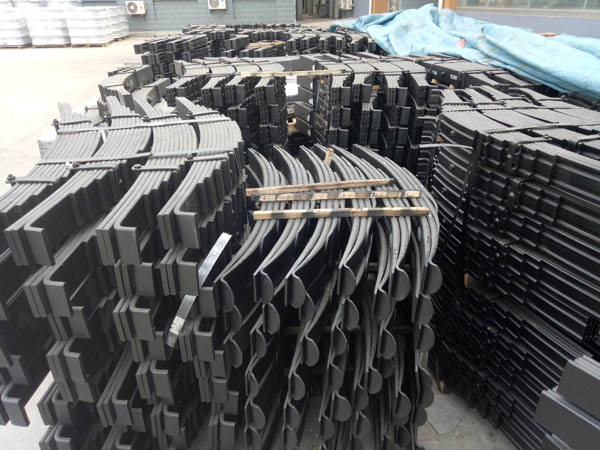
leafspringassembly leafspring
USD $123.00
/ Piezas
Pedido mínimo: 1 Piezas
Términos comerciales admitidos:
FOB
- Precio de referencia:
- USD $123.00
- Cantidad mínima de pedido:
- 1 Piezas
- Plazo de entrega:
- 20 días
- Capacidad de suministro:
- 15,060 Piezas por Semana
- Puerto de envío:
- shandong

- Main leaf: The longest top leaf with rolled eyes at both ends for hinged connection with frame hangers, bearing the main tensile force.
- Auxiliary leaves: Multiple spring‑steel plates with gradually reduced lengths stacked together to share loads.
- Center bolt: Fastens all spring steel plates into an integral unit to ensure synchronous deformation of each leaf.
- U‑bolts: Fasten the leaf‑spring assembly to the vehicle axle.
- Spring clips: Restrict lateral offset of spring leaves and prevent transverse shifting between plates.
- Eye bushings: Installed inside spring eyes, made of rubber or polyurethane, for friction buffering and abnormal noise reduction.
- Limit pads / bump stops: Limit the maximum compression travel of the leaf spring and prevent damage caused by direct hard collision of steel plates.
Core Materials and Manufacturing Processes
- Raw Material: High‑silicon‑manganese spring steel (such as 65Si2Mn), featuring high strength and excellent fatigue resistance, suitable for repeated bending deformation under heavy loads.
- Key Procedures:
- Blanking and stamping: Cut steel plates according to designed dimensions.
- Hot‑rolled eye forming: Heat‑process both ends of the main leaf to form mounting eyes.
- Quenching and tempering heat treatment: Improve steel strength and toughness to avoid fracture.
- Pre‑stressing treatment: Apply reverse stress in advance to extend fatigue service life.
- Shot peening: Surface treatment to eliminate micro‑cracks and improve fatigue resistance.
- Paint coating: Anti‑rust and anti‑corrosion protection against erosion from mud, water and gravel.
Main Functions
- Load‑bearing: Bear the weight of vehicle and cargo, serving as the major load‑bearing component for heavy‑duty vehicles.
- Shock absorption and buffering: Steel plates bend and deform under road bumps to absorb impact from road surfaces.
- Force transmission and guiding: Transfer driving and braking forces, constrain axle position, and realize positioning function without extra guiding mechanisms.
Application Scenarios
Heavy‑duty trucks, semi‑trailers, light‑duty trucks, passenger coaches, construction machinery and off‑road vehicles. Widely applied in cargo transportation, logistics and construction working conditions.
Advantages & Disadvantages
✅ Advantages
- High load‑bearing capacity and strong impact resistance, adaptable to heavy‑load and poor‑road‑surface conditions.
- Simple structure, low manufacturing cost, convenient inspection and field maintenance.
- Reliable force transmission; no complicated air supply system required.
⚠️ Disadvantages
- Inferior riding comfort compared with air‑spring suspension.
- Friction occurs between spring leaves; long‑term overloading may lead to leaf fracture.
- Large unsprung mass, not suitable for high‑speed lightweight transportation.
Installation & Maintenance Notes
- Regularly inspect leaf springs for cracks, deformation and rust; replace damaged parts in time.
- Tighten U‑bolts to specified torque value; avoid over‑tightening or insufficient fastening.
- Inspect spring clips and eye bushings; replace worn bushings to eliminate rattling noise.
- Avoid long‑term overloading, which will greatly shorten service life.
- Properly lubricate friction surfaces to reduce wear between spring leaves.
Especificaciones comerciales
- Precio de referencia
- USD $123.00
- Cantidad mínima de pedido
- 1 Piezas
- Plazo de entrega
- 20 días
- Capacidad de suministro
- 15,060 Piezas por Semana
- Puerto de envío
- shandong
Términos comerciales admitidos:
FOB

Básico
Fundada en 2010

Shandong Shuipo Equipos Mecánicos y Eléctricos Co., Ltd.
- Ubicación
- Parque Industrial de Quanpu, condado de Liangshan, ciudad de Jining, provincia de Shandong (n.º 16 de la carretera nacional 220)
- Productos principales
- Piezas para vehículos comerciales
- Empleados
- Less than 50 People
- Área de fábrica
- 1,000-5,000 m²
- Ingresos anuales
- US$5 Million - US$10 Million
- Mercados principales
- Southeast Asia / South Asia / Middle East & North Africa / Africa