

Introduction
Parts of a semi trailer form an integrated mechanical system in which each component’s function depends on the condition of the others. The chassis frame carries the payload and transfers a portion of it to the tractor through the kingpin. The landing gear supports the trailer’s nose when uncoupled. The axles and suspension carry the rear load and maintain wheel alignment. The brake system converts pneumatic pressure into stopping force at each wheel. A failure in any one component cascades into the others—a worn kingpin accelerates fifth-wheel jaw wear, a misaligned axle consumes tires, and a contaminated air system attacks brake chambers throughout the trailer.
For fleet managers and maintenance planners, understanding the parts hierarchy is the foundation of effective inspection and procurement. A trailer specification sheet lists component categories, but it does not explain which parts fail most often, which are safety-critical, or which are economically repairable versus replaceable. This guide breaks down the semi trailer into its primary structural and mechanical systems, explains the function of each, and identifies the inspection priorities that determine whether a trailer completes its service life without avoidable downtime.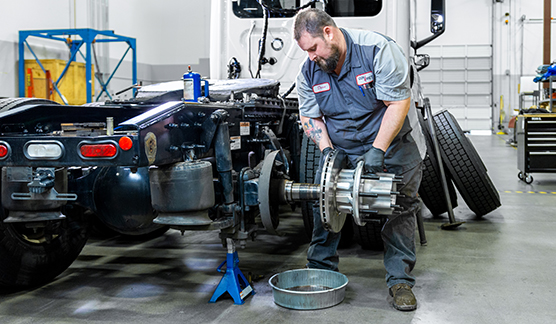
Core Powertrain and Structural Design
Chassis Frame and Upper Coupler
The chassis frame is the semi trailer’s primary load-bearing structure. It consists of longitudinal main beams, cross-members, and the upper coupler assembly at the front. The main beams are typically fabricated from high-strength steel with variable web depths to concentrate material where bending moments are highest—near the fifth-wheel and suspension hanger attachments . The cross-members distribute concentrated loads and maintain beam spacing under torsional stress.
The upper coupler is the reinforced structure that receives the kingpin and transfers vertical and horizontal loads from the tractor into the main beams. It includes a bearing plate that contacts the fifth wheel, the kingpin itself, and the reinforcement structure that ties the kingpin mounting into the main beams . This assembly is a fatigue-critical zone: cracks at the kingpin reinforcement welds or the coupler-to-main-beam connection are structural failures that require qualified repair or replacement.
Kingpin and Landing Gear
The kingpin is the vertical pin that locks into the fifth-wheel jaws, coupling the trailer to the tractor. Its diameter is standardized—2 inches (50.8 mm) for standard duty and 3.5 inches (89 mm) for heavy-haul applications. Wear is measured against a limit; a kingpin worn beyond specification cannot be gripped securely by the fifth-wheel jaws and must be replaced.
The landing gear supports the trailer’s nose when uncoupled. It consists of two telescoping legs, a cross shaft, and a hand crank or hydraulic operating mechanism. Landing gear is a wear item: legs can bend from uneven ground contact, cranks can fail, and the mounting brackets can crack from repeated load cycles . The landing gear’s static capacity (commonly 28 tonnes) must be adequate for the trailer’s nose weight when loaded.
Axle and Suspension Assemblies
The axle assembly includes the axle beam, spindles, hubs, and wheel bearings. Axle capacity ratings commonly fall into 13-tonne and 16-tonne classes for general freight trailers. The axle beam is typically a square or round section with spindle ends machined to accept bearings and brake components . Track width, brake chamber mounting distance, and wheel fixing pattern must match the suspension and wheel specification.
The suspension system connects the axles to the frame. Mechanical leaf spring suspension uses stacked springs, hanger brackets, and equalizer beams to distribute load between adjacent axles. Air suspension replaces the leaf spring with air springs (bellows) and a trailing arm or four-link mechanism, providing ride height control and reduced road shock transmission to cargo . Suspension bushings and equalizer pins are wear items: worn bushings allow axle misalignment, which produces irregular tire wear that the operator may misattribute to tire quality.
Brake System Components
The brake system converts pneumatic pressure into stopping force. Its primary components include brake chambers, slack adjusters, camshafts (for drum brakes), foundation brakes (drums and shoes or discs and pads), and the air control valves that regulate pressure distribution .
Brake chambers are the actuators: air pressure enters the chamber, pushes a diaphragm, and extends a pushrod that rotates the slack adjuster and applies the brake. Pushrod stroke is the primary wear indicator—as lining wears, the pushrod extends further, and when stroke exceeds the adjustment limit, braking force diminishes. Slack adjusters convert pushrod force into camshaft rotation and maintain correct lining-to-drum clearance. Relay valves and emergency relay valves control the timing and pressure of brake applications, and their proper function is essential for balanced braking across the trailer .
Technical Specifications
The table below presents representative parameters for core semi trailer components in general freight service. Values are typical industry references; actual specifications vary by manufacturer, model, and configuration.
| Key Parameter | Typical Technical Specification | Operational Significance |
|---|---|---|
| Main beam height | 450–500 mm (common flatbed/container chassis) | Bending stiffness under concentrated loads; taller beams resist heavier payloads |
| Kingpin diameter | 2 in (50.8 mm) standard; 3.5 in (89 mm) heavy-haul | Coupling interchangeability and load transfer capacity |
| Kingpin wear limit | 1/8 in (3.2 mm) maximum diameter reduction | Beyond limit, jaws cannot grip securely; replacement required |
| Landing gear static capacity | 28 t (common) | Must support loaded trailer nose weight when uncoupled |
| Axle capacity | 13 t (standard); 16 t (heavy-duty) | Per-axle legal ceiling; must match tire and suspension ratings |
| Suspension bushing wear indicator | Visible movement under pry bar load | Worn bushings cause axle misalignment and irregular tire wear |
| Brake pushrod stroke limit | Chamber-specific; exceeds limit indicates lining wear | Beyond limit, braking force diminishes; requires adjustment or replacement |
| Brake chamber operating pressure | 0.8 MPa (normal); 1.0 MPa (maximum) | Force generation at the foundation brake; system must maintain pressure |
Comparative Advantages TCO and ROI
The parts decision that most directly affects total cost of ownership is component specification versus lowest-price substitution. A brake chamber that costs less but fails at 60 percent of the service life of a proven component increases total cost through replacement labor and downtime. A suspension bushing that wears faster than specification allows axle misalignment that consumes tires—a cost that dwarfs the bushing price difference.
A defensible cost comparison requires stated assumptions. Consider a fleet of 50 trailers, each requiring four brake chambers per axle group. If a lower-cost chamber priced at 280 CNY fails at 18 months instead of the 24-month service life of a 400 CNY chamber, the annualized cost per position rises from approximately 200 CNY to approximately 187 CNY—a marginal difference that disappears when the labor and downtime of an additional replacement event are included. The lower-cost component is not cheaper in service.
Suspension bushing quality follows a similar logic. Bronze or mixed-material equalizer bushings may cost more than rubber bushings, but their wear rate under heavy load is typically lower, and they maintain axle alignment more consistently over the service interval. For fleets operating on routes with frequent tight turns or poor road surfaces, the bushing upgrade often pays back within one tire replacement cycle through reduced irregular wear.
Landing gear maintenance is another cost driver that is often deferred. A landing gear that is not lubricated at manufacturer intervals will seize or wear prematurely, requiring leg replacement or rebuild. The cost of lubrication at each PM interval is negligible against the cost of a landing gear failure during loading.
Heavy Duty Application Scenarios
-
General freight and distribution: The standard parts profile includes a flatbed or van chassis, 13-tonne axles, mechanical or air suspension, and a conventional air brake system. Inspection priority is brake stroke, suspension bushing condition, and kingpin wear.
-
Container drayage and port operations: High-frequency coupling accelerates kingpin and upper coupler wear, while short trips increase brake cycling. Landing gear and brake chamber inspection intervals should be shortened for this duty cycle .
-
Construction and heavy haulage: Heavy loads and rough surfaces stress the chassis, suspension, and landing gear. Reinforced main beams, 16-tonne axles, and heavy-duty suspension components are typical. Structural crack inspection at suspension hanger welds and cross-member intersections is a priority.
-
Heavy machinery transport (lowbed): The hydraulic gooseneck is a critical component in addition to the standard parts. Hydraulic cylinder seals, hoses, and valve function determine whether the trailer can be detached and loaded safely. The lowbed’s deck height and axle configuration are determined by the machinery’s dimensions and weight.
Selection and Maintenance Considerations
Parts selection begins with dimensional and load compatibility, not price. The axle must match the suspension spring seat dimensions and brake chamber mounting pattern. The brake chamber must match the foundation brake type and the required torque for the axle load. The kingpin must match the fifth-wheel jaw specification and the trailer’s weight class.
Key maintenance practices for semi trailer parts include:
-
Measure brake pushrod stroke at every PM interval. When stroke approaches the adjustment limit, investigate lining wear and slack adjuster condition before replacing the chamber. Air line contamination from a failed tractor dryer is a common cause of chamber diaphragm failure.
-
Inspect suspension bushings and hanger welds. Worn equalizer bushings allow axle misalignment and should be replaced in sets. Hanger welds should be inspected for cracks, particularly on high-mileage trailers or those with a history of overload.
-
Verify kingpin diameter and upper coupler condition. A worn kingpin can be detected by coupling looseness or by measurement against the standard diameter. Cracks at the upper coupler reinforcement welds require qualified repair.
-
Lubricate landing gear at manufacturer intervals. Seized or worn landing gear can fail during loading, creating a safety hazard and a costly repair.
Conclusion
The parts of a semi trailer are an interdependent system in which structural integrity, coupling security, and brake performance are linked. The chassis frame and upper coupler carry the load; the kingpin and landing gear manage the tractor interface; the axles and suspension maintain wheel position; the brake system converts air pressure into stopping force. A weakness in any one component propagates into the others.
Commercially, the parts decision is a cost-per-kilometer decision. The lowest unit price is rarely the lowest total cost when failure frequency and labor hours are included. Fleets that specify proven component grades, track replacement intervals by position, and inspect wear items at defined intervals achieve lower maintenance cost and higher resale value than fleets that replace parts reactively. The engineering and the economics point in the same direction: specify for the duty cycle, maintain on a schedule, and replace before failure.