

Overview
Deploying an amphibious excavator for water conservancy projects involves critical pre-sales evaluation and strict adherence to post-sales maintenance schedules to ensure equipment longevity. This FAQ addresses the most common high-intent questions from fleet managers regarding payload capacity, engine emissions, attachment compatibility, and service intervals for these specialized machines operating in swamps, rivers, and wetlands .
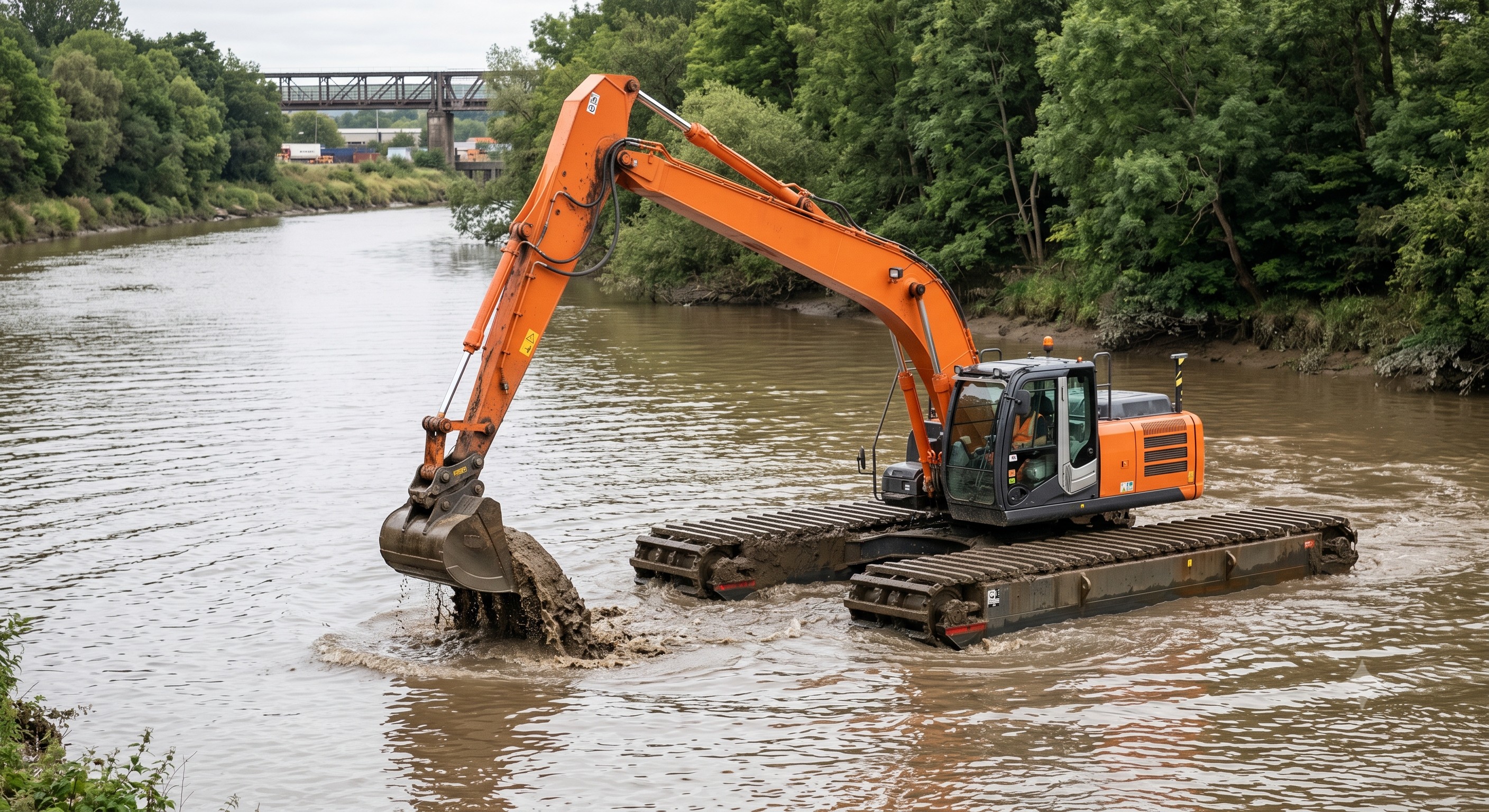
Frequently Asked Questions
Q1: What is the standard maintenance interval for an amphibious excavator used in water conservancy?
The standard maintenance interval for an amphibious excavator follows a multi-tiered schedule based on engine hours, ranging from daily checks to major overhauls every 4,500 hours. Following the OEM guidelines and DPWH standards, you must perform daily (10 hours) checks like greasing pivots and checking fluid levels . Weekly (50 hours) service involves greasing arm and bucket joint pins, while monthly (250 hours) and quarterly (500 hours) services require filter changes and greasing of swing gears . Semi-annual (1,000 hours) and annual (2,000 hours) intervals demand more comprehensive fluid changes, and a major undercarriage inspection is recommended every 4,500 hours or 2.5 years .
Q2: What is the typical maximum payload and operating weight range for these machines?
The typical operating weight for amphibious excavators ranges significantly, from compact 2-ton units up to massive 40-ton giants, with pontoon design heavily influencing payload capacity. For small-scale ditch cleaning, machines like the Waterking WK 20 NG-A start at 2 tons, while standard dredging units often fall in the 15 to 22-ton range (WK 150/220) . High-capacity models, such as the 40-ton WK 400 or the 30-ton Kobelco SK200-based units, are used for heavy riverbed work and can have bucket capacities up to 0.9 m³ .
Q3: How does the engine Tier emission standard affect amphibious excavator procurement?
Engine Tier emission standards directly determine the environmental compliance and availability of the excavator for specific projects, with Tier 4 Final engines required in many regulated regions. You can find Tier 2 engines in some models like the XE215SLL, but these may have deployment restrictions in emission-controlled zones . Modern engines often feature Tier 4 Final compliant systems equipped with EGR, DOC, and SCR-Urea to reduce NOx and particulate matter . When procuring, ensure the engine family (e.g., LSZXL05.2QXA) matches your project's emission requirements .
Q4: Can I use standard excavator attachments with an amphibious undercarriage?
Yes, amphibious excavators are designed with high versatility, allowing the use of standard and specialty attachments, often featuring a replaceable joint unit between the excavator and the pontoon. This design enables you to equip different brands of excavators with various attachments . Common attachments include buckets, extended booms, and sticks for dredging, and specialized options like flail mowers, cutter suction dredgers, and hydraulic hammers . However, you must verify the weight and hydraulic flow compatibility of the attachment with the specific amphibious model to maintain stability .
Q5: What type of hydraulic fluid is recommended and when should it be replaced?
It is recommended to inspect the cleanliness of the hydraulic oil every 500 hours and change the hydraulic fluid according to the OEM schedule, typically at major service intervals. Doosan and other manufacturers emphasize the importance of using approved engineering standards for hydraulic fluid to avoid compatibility issues and maintain performance . Regular checks for leaks in the oil lines are crucial , and you should replace the hydraulic oil return filter and pilot filter during the 250-hour and 1,000-hour maintenance intervals .
Q6: What are the critical pre-deployment checks for pontoon stability?
Critical pre-deployment checks include inspecting the pontoons for leaks or damage, ensuring the track chain tension is correct, and verifying the spud piles (if installed) are ready for deployment. Before entering the water, you must inspect the pontoon structure for cracks or faulty welds . The track chains require specific tension adjustments, and you should check the drive sprockets and chain tensioners to prevent unexpected failures in soft terrain . Also, verify the Multi-Synchronous Drive System (if equipped) is functioning to ensure superior tracking power .
Q7: Where can I source spare parts for my amphibious excavator?
Spare parts should ideally be sourced through the original equipment manufacturer (OEM) or their authorized dealers to ensure compatibility, especially for the complex undercarriage components. However, many manufacturers offer a 'Plug & Play' one-stop-shop solution, ensuring support for parts and service . It is advisable to maintain a stock of critical components like travel motor oil, gear oil (85W-90), and track chain components to minimize downtime in remote water conservancy sites .