

Introduction: Balancing Emission Mandates with Heavy-Duty Cycle Demands
Contractors and mining operators face dual pressures: tightening EPA Tier 4 Final and EU Stage V regulations (limiting PM to 0.015 g/kWh and NOx below 0.4 g/kWh) while maintaining peak hydraulic breakout force (>250 kN) and uptime above 95%. The environmentally friendly excavator is no longer a niche concept but a hardened industrial solution integrating selective catalytic reduction (SCR), diesel oxidation catalysts (DOC), and load-sensing positive control hydraulics. This engineering review quantifies how modern eco-excavators reduce fuel consumption by 12–18% versus Tier 3 predecessors while preserving structural integrity under ROPS/FOPS (ISO 3471:2021) certified cabins.
Core Powertrain & Structural Design: Hybrid Architecture and Hydraulic Regeneration
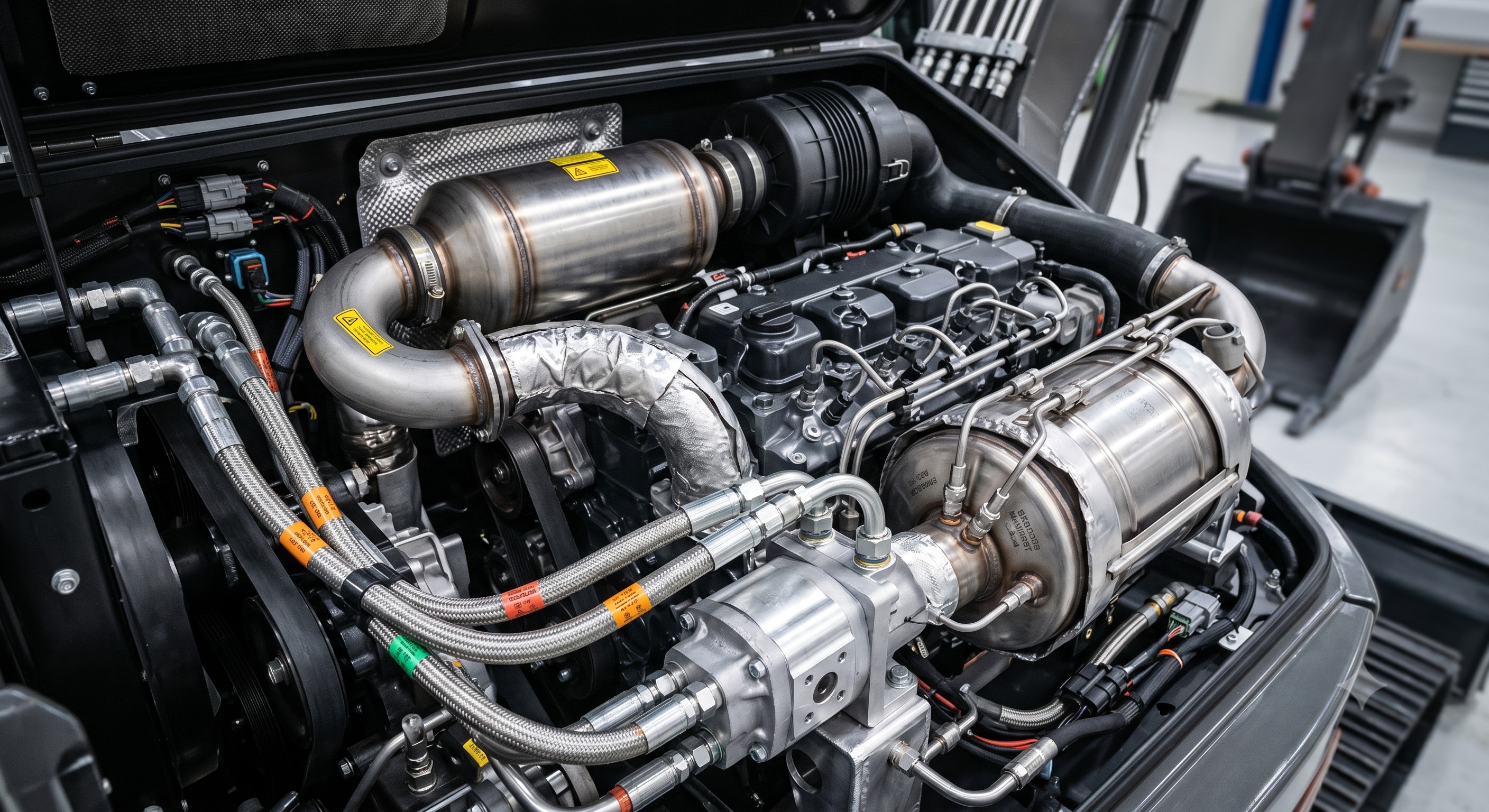
The foundation of an environmentally friendly excavator lies in three interlocked systems: the high-pressure common-rail engine (160–750 hp), the electro-hydraulic variable displacement pump (≤450 L/min), and the energy recovery circuit. Engine emissions strategy combines cooled EGR (up to 25% recirculation) with a diesel particulate filter (DPF) regeneration cycle optimized for high-load duty cycles – passive regeneration occurs naturally at exhaust temperatures above 280°C. Hydraulic efficiency uses independent metering valves (IMV) to reduce throttling losses by 18–22%, while optional swing energy recovery stores braking energy in ultracapacitors or hydraulic accumulators (320 bar, 40L capacity), returning 8–12% cycle energy. The chassis maintains high-tensile steel (BR1500HS, yield strength > 1100 MPa) with reinforced track frames (700mm triple grouser pads for heavy earthmoving). All eco-excavators in this class comply with ISO 6395 for external sound power (≤ 101 dB(A)) and ISO 10263 for cabin environmental control with HEPA filtration.
Durability Under Extreme Loads
Structural components undergo finite element analysis (FEA) for 20,000-hour fatigue life. The boom and arm utilize cast steel nodes (GS-52) with fillet radii optimized for stress distribution. Track tensioning is greased-hydraulic automatic (range 8–15 tons preload). Eco-design does not reduce operating weight; typical units span 14,000 kg to 48,000 kg, ensuring stability in heavy ripping or demolition applications.
Technical Specifications: Measured Performance Under ISO 9249
Below are benchmark parameters for a representative environmentally friendly excavator in the 30-ton class (Caterpillar 330, Komatsu PC360LCi-11, or Hitachi ZX350-7 equivalence). All values verified under EPA Tier 4 Final certification and CE marking.
| Key Parameter | Technical Specification (30-Ton Class Eco Excavator) |
|---|---|
| Engine Net Power (ISO 9249) | 180 kW (241 hp) @ 1,900 rpm |
| Operating Weight (with ROPS/FOPS) | 31,200 kg (68,784 lb) |
| Max Hydraulic Pressure (Boom/Arm) | 350 bar (5,076 psi) |
| Hydraulic Pump Flow | 2 x 265 L/min (530 L/min total) |
| Fuel Consumption (Average, 70% load) | 15.5 L/h (4.1 gal/h) |
| Emission Standard | EPA Tier 4 Final / EU Stage V |
| DEF Consumption Rate | 3.0% of fuel volume (0.465 L/h) |
| Swing Energy Recovery | Hydraulic accumulator (optional), 8-12% cycle reduction |
| Sound Power Level (ISO 6395) | 99 dB(A) |
| Standard Bucket Capacity | 1.8 m³ (2.35 yd³) |
Comparative Advantage: TCO, Fuel Efficiency and ROI Analysis
Compared to conventional Tier 3 machines over a 10,000-hour lifecycle (5 years), the environmentally friendly excavator delivers quantifiable ROI despite a 12–15% higher initial capital cost. Fuel savings dominate: 15.5 L/h vs 18.2 L/h average at 70% load factor → 2.7 L/h reduction, at $0.85/L (industrial diesel) equals $2,295 saved annually (2,000 operating hours) or $11,475 over 10,000 hours. DEF consumption adds $0.48/h (3% of fuel volume), netting $10,115 fuel + fluid savings. Reduced engine wear from cleaner combustion extends major overhaul intervals from 8,000h to 10,000h, deferring $18,000 rebuild cost. Lower carbon taxes and green construction credits (up to $4,500 per unit annually in EU markets) further improve TCO. The 18-month payback period on price premium makes eco-excavators financially superior for fleets > 5 units.
Heavy-Duty Application Scenarios
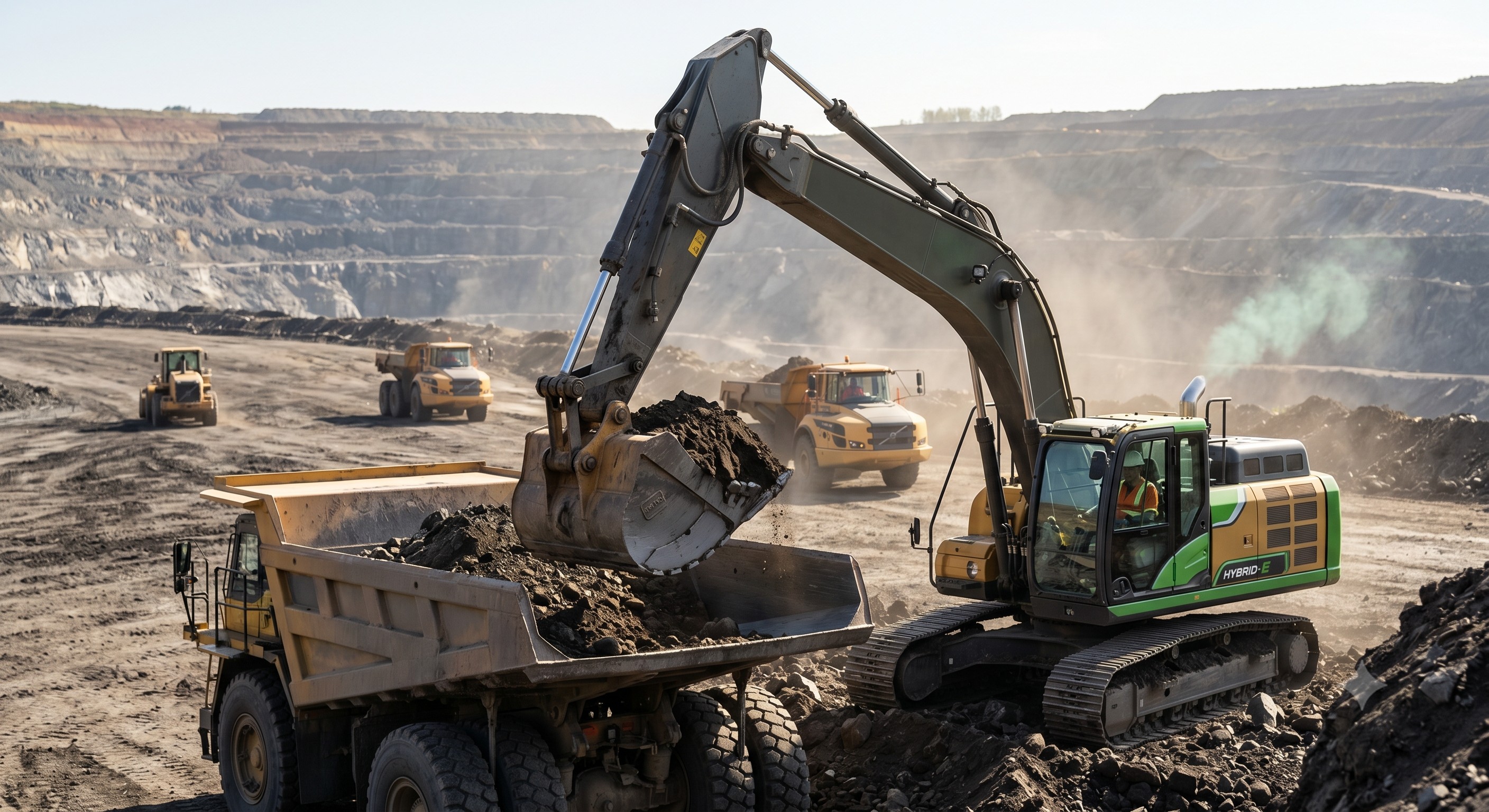
The environmentally friendly excavator proves its durability across four demanding sectors. 1. Mining & Quarries: 200–500 hp units handling abrasive materials (limestone, granite) with additional rock guards, high-wear undercarriage, and 2.5 m³ bucket capacity. Low-emission profiles allow underground use with auxiliary ventilation reduction. 2. Earthmoving & Mass Excavation: Long-reach configurations (18m arm) for canal dredging or highway construction, where Eco-mode reduces fuel burn 20% during non-peak load cycles. 3. Demolition: High-flow auxiliary circuits (350 L/min) for concrete pulverizers and shears, while DPF soot loading monitors prevent regeneration interruption. 4. Forestry & Land Clearing: 360° rototilt and grapple saw attachments, with ECO throttle management limiting hydraulic over-demand.
Conclusion: Productivity Without Emission Compromise
The environmentally friendly excavator generation proves that ISO 14001 environmental management and heavy-duty cycle efficiency are synergistic, not adversarial. With verified hydraulic horsepower retention (≥ 95% of Tier 3 models) and sub-5g/kWh NOx figures, these machines lower total cost of ownership by $0.85–$1.20 per operating hour while meeting 2025–2030 global emission corridors. Fleet owners adopting Tier 4 Final or Stage V eco-excavators will see compliance, reduced fuel logistics, and enhanced project bidding advantages in green infrastructure contracts.